
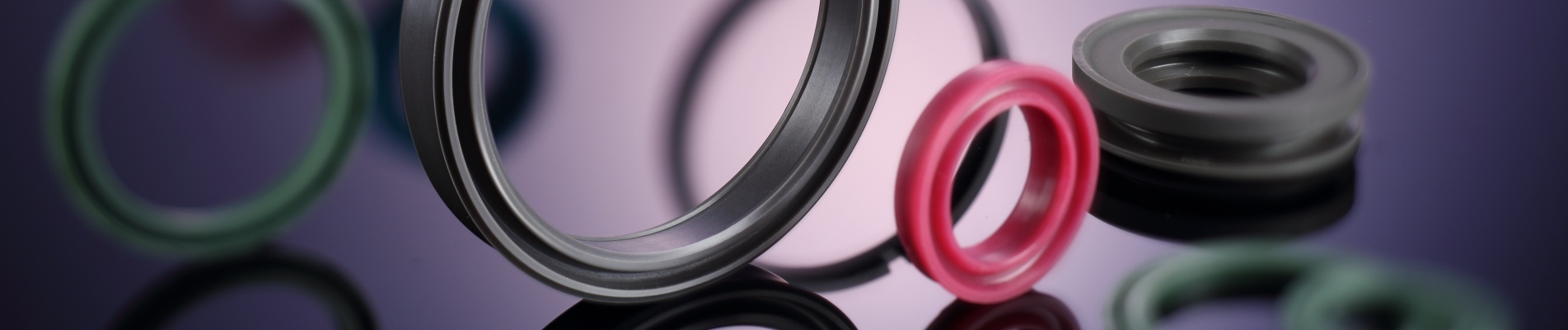
Hydraulic rod seals and piston seals both play essential roles in hydraulic cylinders, but they serve different purposes. A rod seal prevents hydraulic fluid from leaking out along the piston rod, while a piston seal prevents internal leakage between the two sides of the piston.
What Is a Hydraulic Rod Seal?
Hydraulic rod seals are installed between the cylinder head (gland) and the piston rod. Their primary function is to prevent hydraulic fluid from leaking out of the cylinder along the moving piston rod. They also work alongside rod wiper seals, which help prevent external contaminants such as dirt, water, and abrasive particles from entering the hydraulic system.
Because hydraulic rod seals operate under dynamic conditions, they must maintain reliable sealing performance while withstanding friction, wear, and operating pressure. Their performance depends on several factors, including the seal profile, seal material, piston rod surface condition (such as surface roughness (Ra), surface hardness, and coatings), and installation dimensions.
Voneseals Hydraulic Rod Seals
Voneseals offers a range of hydraulic rod seals designed for different operating conditions, with various profiles, materials, and sizes available.
The appropriate rod seal should be selected according to the cylinder's operating pressure, temperature, hydraulic fluid, movement speed, and installation dimensions.

What Is a Hydraulic Piston Seal?
A hydraulic piston seal is installed on the piston inside a hydraulic cylinder. Its main purpose is to separate the two pressure chambers of the cylinder, prevent fluid bypass between them and maintain the actuation force. In hydraulic applications, it also helps retain the oil and maintain the differential pressure between both sides of the piston.
By minimizing internal leakage, piston seals help maintain pressure separation and support efficient cylinder operation.
Piston seals are used in both single-acting and double-acting hydraulic cylinders. The appropriate design depends on the cylinder's pressure arrangement, seal structure, and operating conditions. For double-acting cylinders, the piston seal must be designed to provide sealing in both directions.
When selecting a piston seal, important considerations include operating pressure, reciprocating speed, cylinder bore diameter, groove dimensions, and extrusion resistance.
Single-Acting vs. Double-Acting Piston Seals
The correct design should match the hydraulic cylinder's operating principle and sealing requirements.
Voneseals Hydraulic Piston Seals
Voneseals provides hydraulic piston seals in different designs for a range of hydraulic applications. The product range includes options for different pressure conditions, materials, and cylinder configurations.
Key differences between a Rod Seal and a Piston Seal
Although both rod seals and piston seals are used in hydraulic cylinders, their installation locations and sealing functions are different.
| Comparison | Hydraulic Rod Seal | Hydraulic Piston Seal |
| Installation location | Between the cylinder head and piston rod | On the piston |
| Primary function | Prevent external fluid leakage | Prevent internal leakage |
| Sealing interface | Piston rod and cylinder head | Piston and cylinder bore |
| Main purpose | Keep hydraulic fluid inside the cylinder | Maintain pressure separation between chambers |
| Key dimensions | Rod diameter and rod seal groove dimensions | Cylinder bore and piston seal groove dimensions |
| Key selection factors | Pressure, rod speed, temperature, fluid, and surface condition | Pressure direction, bore size, speed, fluid, and groove design |
The key difference is the leakage path each seal is designed to control. A rod seal prevents fluid from escaping along the piston rod, while a piston seal prevents fluid from passing between the two sides of the piston.
In most conventional hydraulic cylinders, rod seals and piston seals work together rather than replace one another. Each must be selected according to its specific function within the sealing system.
Can a Seal Serve Both the Piston and the Rod?
In most hydraulic cylinders, piston seals and rod seals are designed for different sealing locations and functions, so one seal should not automatically be used for both applications. A rod seal prevents hydraulic fluid from leaking along the piston rod, while a piston seal prevents fluid from bypassing the piston between the two pressure chambers.
Some seal designs may be suitable for both applications, but this depends on their profile, groove dimensions, pressure conditions, movement type, and material properties. Always check the manufacturer's specifications and confirm compatibility with the cylinder design before selecting a replacement seal.
Common Problems Caused by Incorrect Seal Selection
Incorrect seal selection can lead to leakage, premature wear, or unreliable cylinder operation. However, the actual cause should always be evaluated in the context of the entire hydraulic system.
Replacing a seal without checking the surrounding components may not resolve the root cause. Inspecting the cylinder and confirming the operating conditions can help identify a more appropriate sealing solution.
FAQ
Does every hydraulic cylinder need both rod seals and piston seals?
Many conventional hydraulic cylinders use both types, but the exact sealing arrangement depends on the cylinder design and application. Additional components, such as wiper seals, buffer seals, and guide rings, may also be required.
Why are some rod seals paired with a buffer seal?
Because pressure spikes in heavy-duty hydraulic cylinders can damage a primary rod seal in short order. The buffer absorbs the spike and protects the primary seal, which then handles steady-state sealing. The wiper sits downstream and keeps contamination out. Three parts, three jobs, working together to extend the life of the whole assembly.
How often should hydraulic seals be replaced?
This depends on operating conditions, but visible leaks or slow cylinder movement mean it is time for an inspection.
Leave A Message
Scan to wechat :